

In Alberobello, the first glance often travels upwards: towards the conical roofs arranged above white walls. Tatilmerkezi’s Stork suggests slowing down and reading the two neighbourhoods separately rather than racing after that first view. A roofline, a narrow street and a quiet lunch table can make a full town visit. Treating the place merely as a photograph stop loses the scale of the houses. Give the day to walking, several small rests and one museum choice, and the story has more space to unfold.
This route considers Rione Monti, Aia Piccola, Casa Pezzolla and Trullo Sovrano as parts of one flexible plan. They do not all demand the same pace. Someone who enjoys streets can shorten the museum element, while a visitor interested in construction may want more time to consider how the exterior form relates to an interior. The pleasure is not in counting every conical roof but in understanding how the buildings sit together. Choose your emphasis before turning the town into a list of compulsory stops.
Aia Piccola: return to the scale of the street
Begin with a modest stretch of Aia Piccola rather than assuming every doorstep is a visitor space. The Municipality of Alberobello describes this southeastern neighbourhood as a part not transformed by commercial activity. Around Via Giuseppe Verdi, small passages, house fronts and courtyards provide a useful starting point for observing scale. You do not need to finish every line on the map. Notice how one or two turns change the perspective between buildings, and let that shape the next part of the walk.


Stepping backwards for a photograph is not always possible in a narrow lane, so leave room for other people to move. Rather than repeating the same white-wall picture, look at the proportion between door and roof, the way a wall turns towards a street, or the space separating two homes. An open doorway is not an invitation to enter without permission. This is a used neighbourhood as well as a visitor destination, and a walk that respects the difference can be a better experience for everyone.
Rione Monti: follow the rhythm of the roofs
Giving Rione Monti its own walking block makes the contrast between the neighbourhoods easier to notice. As you move uphill, leave time for details at street level instead of continually seeking a new panorama. If you want to browse shops, place that towards the end of the outing so shopping and observing buildings do not interrupt one another. Small pauses on the slope can keep the visit comfortable, especially on a hot day. A compact town still deserves more than a hurried circuit.


UNESCO describes the trulli as limestone dwellings built using dry-stone construction, and records the site’s inscription in 1996. Those facts move the roof beyond a storybook image. The arrangement of stone, the size of a house and its position beside a street belong in the same picture. There is no need to climb roofs or touch the masonry to test how it works. Looking from the public walking route is enough to begin appreciating the relationship between construction and everyday settlement. Save a close-up for a detail you can see without crossing somebody’s boundary.
Trullo Sovrano: a northern building pause
Place Trullo Sovrano in a separate northern extension of the morning or afternoon. Italy’s Ministry of Culture introduces it as a two-storey house museum built for the Perta family in the middle of the eighteenth century, north of the town behind the Santi Medici church. Focusing on one building after the neighbourhood walk creates an opportunity to think about a different arrangement of the familiar form. It can be more useful than adding yet another broad street photograph.


If you plan to go inside, connect the day’s visitor conditions with the order of your route. This guide does not use a fixed opening time or admission price, and museum time must come from the same day that also contains lunch and the return journey. If you prefer an exterior visit, avoid reducing it to a single hurried shot. Spending a little time in front of one house may leave a clearer memory than passing dozens of roofs rapidly. Choose the experience that fits your interest rather than treating entry as compulsory.
Casa Pezzolla: add local life to the picture
Consider Casa Pezzolla after the Aia Piccola walk. The municipal museum record places Museo del Territorio within the setting of Murgia dei Trulli e delle Grotte. A stop like this can add settlement and everyday production to a collection of white-house photographs. An indoor museum and an outdoor lane are different experiences, and shortening one to leave room for the other is a matter of personal interest. You do not have to give every element an identical amount of time.
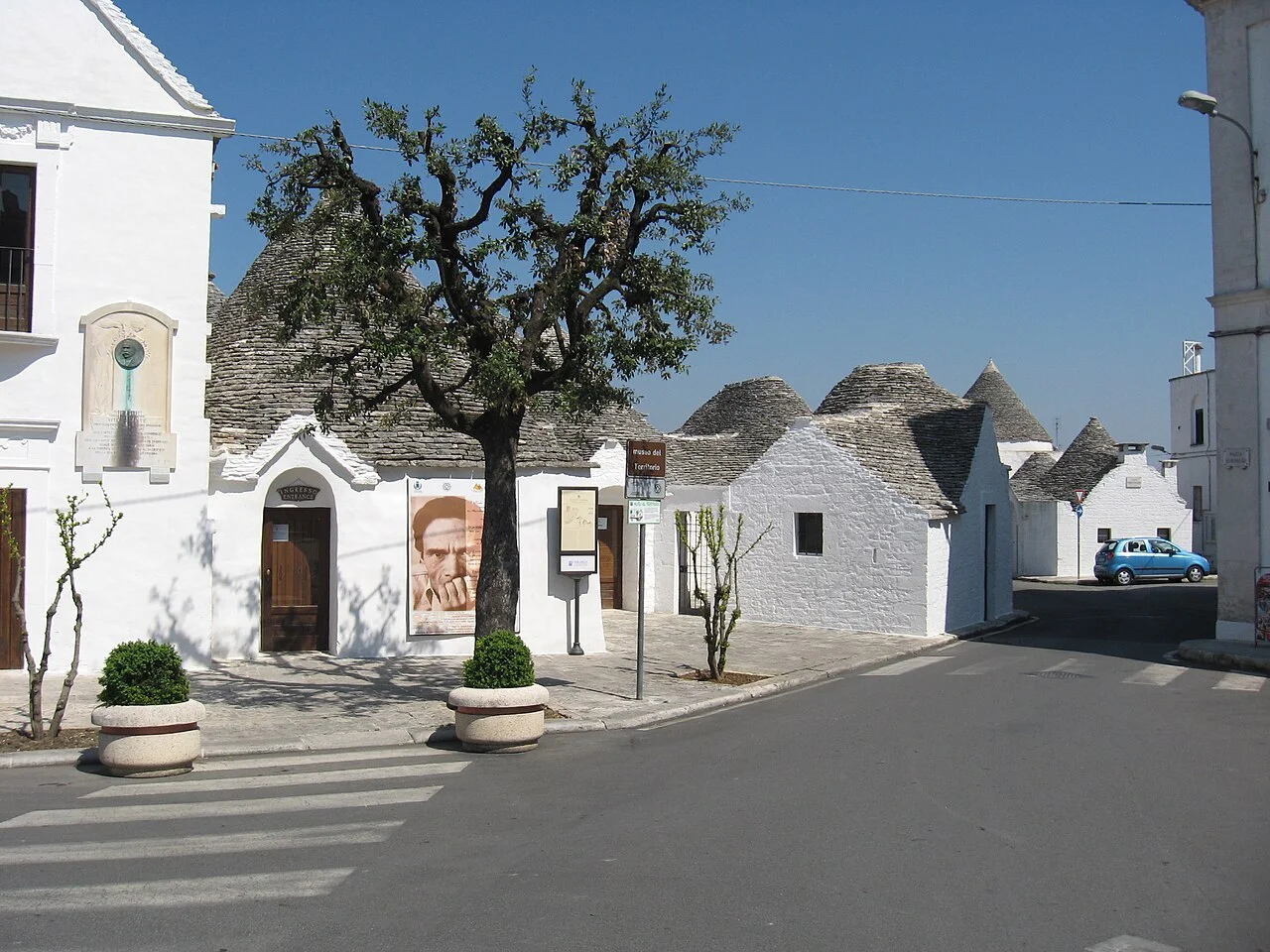

Build the day’s picture selection with the same principle: a broad roof view, a street scene in Aia Piccola, a different angle in Monti and one historic building. Let them be separate moments rather than crops of one favourite image. Instead of repeating the same pose at each facade, lower the camera at a corner and notice how the routes join. A short walk without taking a photograph can be one of the most satisfying parts of a small-town visit. It also gives your eyes a break from comparing the scene with the screen.
Lunch, arrival and the choice of where to stay
For lunch, consider regional Puglian names such as orecchiette, taralli or friselle. They should not be presented as foods unique to Alberobello; the national tourism portal lists them among the region’s flavours. A seated pasta lunch after a longer walk and a smaller bakery pause offer two different rhythms. You do not need to combine both at every stop. Treat water and a shaded rest as part of the itinerary so the final lanes remain enjoyable on a warm day. The meal can provide a genuine pause rather than a gap to be filled quickly.
Keep arrival from Bari or another city separate from the town walk when planning transport. Use Ferrovie del Sud Est’s official information for the travel-day option instead of assuming a particular ticket or departure will be available. With a car, choosing a parking or accommodation point and walking the historic streets is a practical approach. Stone surfaces and slopes mean comfortable shoes may matter more than the duration suggested by a map. Leave a little time between the final photo and the return connection so lunch does not have to be cut short.
An overnight stay is an editorial option for travellers who want to spread the visit across more of the day. If you choose a trullo-shaped room, look carefully at doorway, steps, ceiling and luggage access in the listing. A striking building photograph does not guarantee the same comfort for every guest. On a day trip, keep Aia Piccola and Monti as the two main blocks and choose just one museum addition. The Stork’s suggestion is to leave remembering the street where you slowed down, rather than the number of roofs you managed to see.