
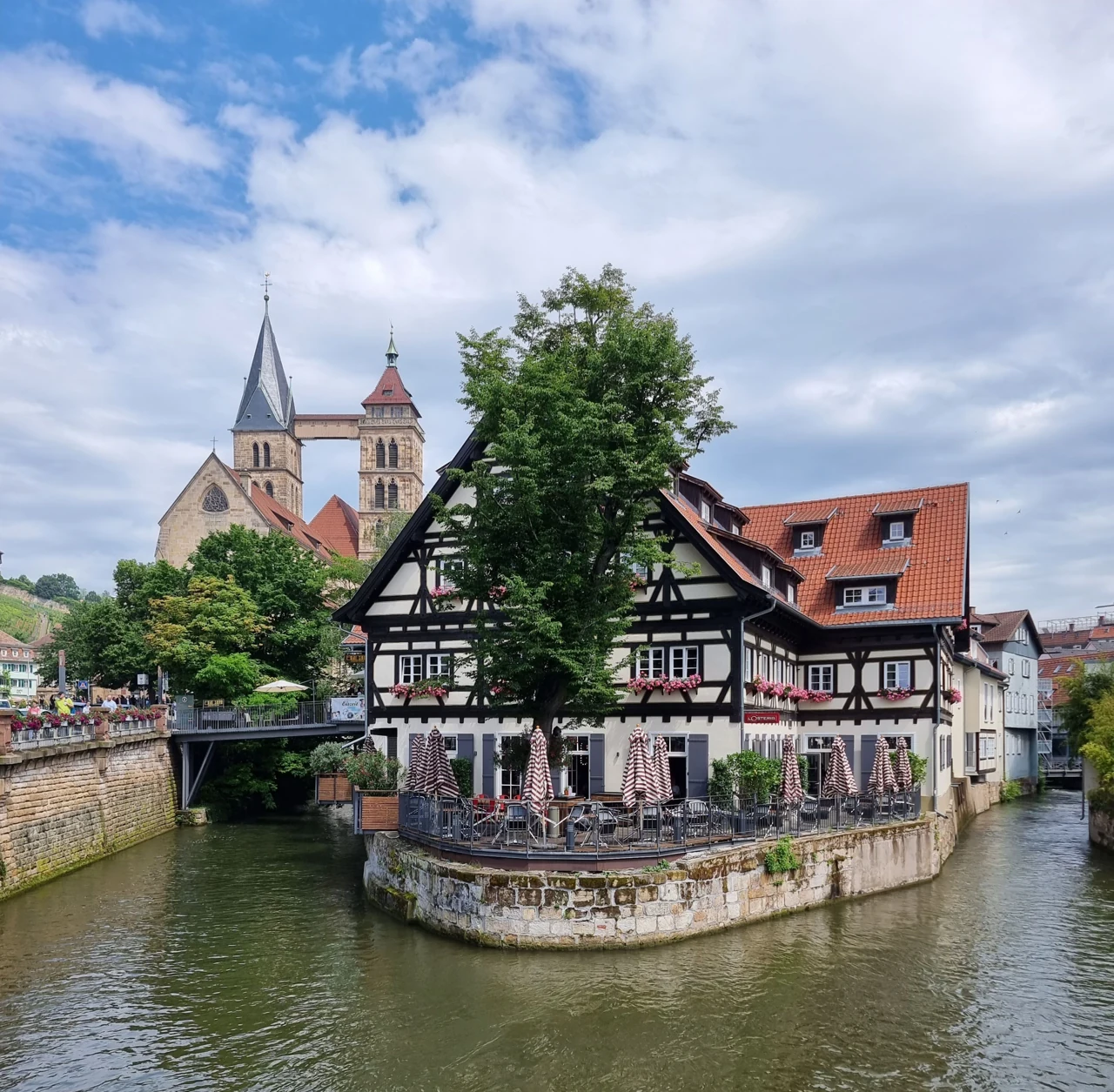
A useful first day in Esslingen am Neckar separates the lower town around its waterways from the city fortifications above it. Put a proper meal between the two, and the visit develops a shape instead of becoming a race between timbered façades and staircases. From the station, work towards Innere Brücke and the Maille area, then continue to Marktplatz, St Dionys and the Old Town Hall. Climb to the Esslinger Burg later if your energy and the weather allow. With only half a day, completing the lower-town walk can be more rewarding than taking a hurried panorama while missing the streets below.
Arriving by train and using the water to orient yourself
Esslingen (Neckar) station is at Bahnhofsplatz 1. Check your actual Stuttgart connection and return service rather than treating regional trains and the S-Bahn as interchangeable: their stopping patterns differ. If you change trains, save the station and platform details as well as the city name. The station's lift and disruption information matters particularly if you have limited mobility. An accessible way off a platform does not establish that every subsequent bridge, lane and uphill section is step-free.
Once you reach the centre, use the waterways as an orientation tool. Innere Brücke and the Maille surroundings show that Esslingen has a spatial identity beyond its timbered façades. Mark the bridges and squares on the official city plan. Pause on both sides of a bridge and compare the buildings as seen from the water with the same buildings from the street. This is more revealing than simply following a list of photo spots. Give pedestrians room in narrow passages and take account of slippery stone surfaces after rain.
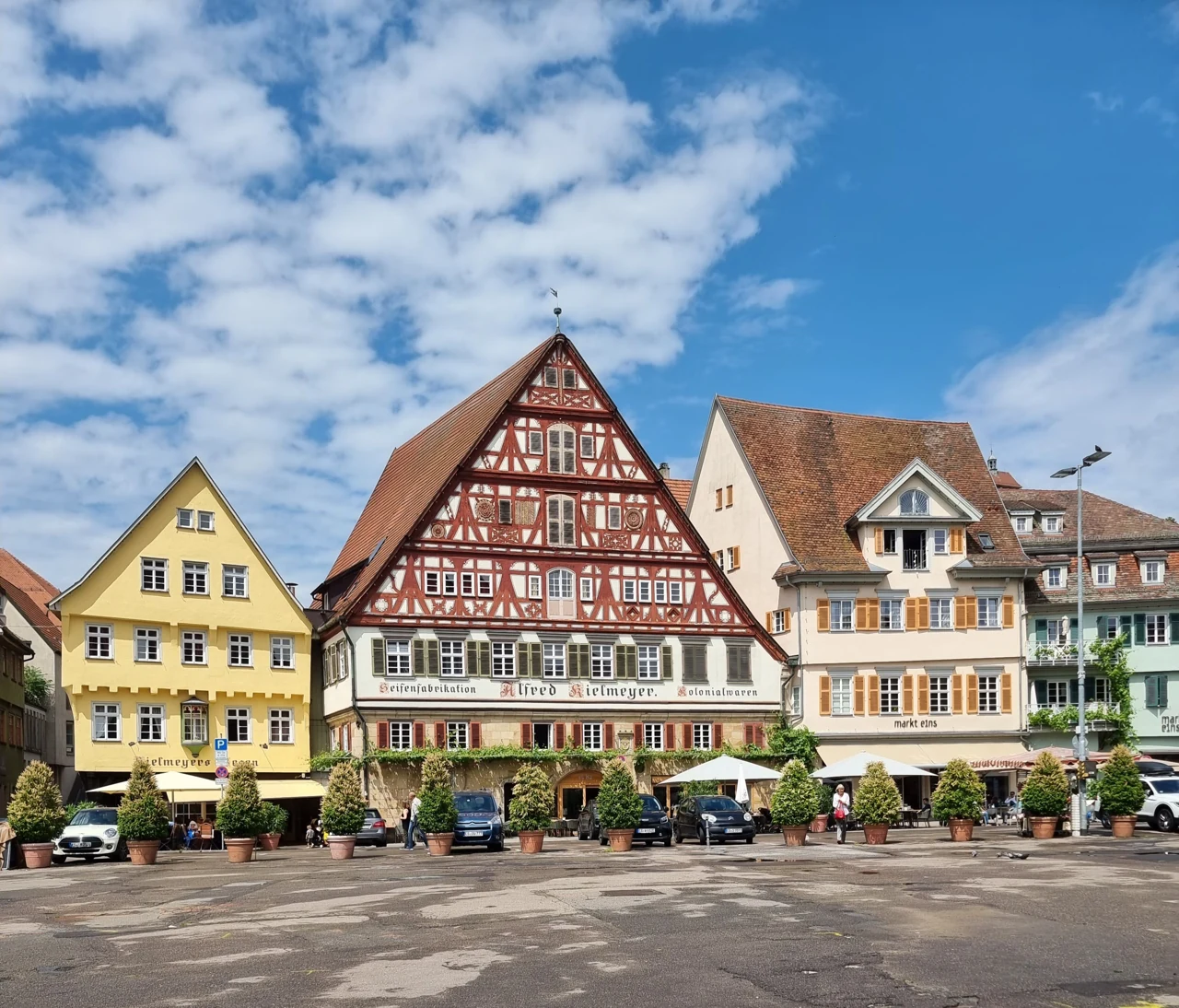
Marktplatz and St Dionys: church access and underground archaeology differ
On Marktplatz, consider the Kielmeyerhaus and surrounding façades as part of the whole square. Framing one attractive building is straightforward; stepping back reveals the relationship between church, commerce and daily activity. Market stalls or events can change how you move through the space, so adjust to the arrangements you find. A photograph of an empty square is not a promise that it will be empty during your visit. A short seated break here can also make the next indoor stop more attentive.
St Dionys town church gives you a way to compare different building periods. Outside, notice the connection between its two towers; inside, spend time with the choir and stained glass where access permits. The archaeology beneath the church is a separate planning question. The official description links visits to the excavations with the Keller, Krypta, Katakomben city tour. Do not assume you can wander underground simply by entering the church. If the earlier settlement history is your main interest, investigate the tour in advance and place its scheduled departure at the centre of your day. Respect worship and the limits of visitor access.

The Old Town Hall and lanes at a smaller scale
Continue towards the Altes Rathaus and look at it first from within its surrounding public space. Then choose short explorations towards Hafenmarkt and Webergasse. Timber-framed buildings reward close observation of projecting storeys, window arrangements and the different scale of adjoining houses. You do not need to approach someone's doorway to appreciate those details. An appealing historic building may be a home or workplace, and an open door is not an invitation to visit its interior.

There is little benefit in making every old-town lane another compulsory stop. Choose two or three short streets and return to the main route to keep your bearings. In wet weather, shorten this section and bring your indoor meal forward. Photographs of the town hall illuminated with winter decorations record a particular seasonal setting; they should not create an expectation of the same lights or market throughout the year. If your dates coincide with an event, allow additional time for crowds, dining and the walk back towards the station.
A specific main course at Palmscher Bau
Palmscher Bau at Innere Brücke 2 is a real restaurant that fits the lower-town walk. Its currently published operator menu lists Schwäbischer Zwiebelroschtbrate: 180 grams of grilled Irish roast beef with fried onions, half a Maultasche, homemade egg Spätzle and mixed salad. That makes a concrete full meal rather than a suggestion to snack on an unspecified regional speciality. Ask about the filling and sauces when dietary requirements matter; the main meat being beef does not establish that every component of the plate meets your preference.
The same menu identifies a falafel bowl as vegan, with pumpkin falafel, couscous, hummus, vegetables and leaf salads. Confirm current service and a reservation with the restaurant. If you intend to climb to the fortifications, leave a comfortable pause after a substantial meal instead of immediately hurrying up the stairs. If the weather turns, you can keep the Burg for another visit and finish with a shorter water-side circuit. The day still has a complete lower-town story, rather than depending on one viewpoint being available.

Esslinger Burg: understanding a fortification above the town
Despite its familiar name, the Esslinger Burg was a projecting part of the city's defences rather than an aristocratic residential castle. Read the Dicker Turm, Hochwacht and Seilergang with that function in mind. The climb is a separate physical commitment from the lower-town walk. Compare stairs and sloping routes on a map; a short distance is not necessarily an easy journey for someone with restricted mobility. On wet steps or in crowds, avoid blocking the route for a photograph.
At the top, first take in the overall view and locate the squares and church towers you visited earlier. The panorama then completes the street-level experience. Events can affect use of Burgplatz, so check an outdoor programme separately from ordinary sightseeing. Do not leave the descent until just before your train departs. For an overnight stay, Hotel am Schillerpark is a real option at Neckarstraße 60. Its contact page lists limited reception hours, making advance arrangements worthwhile for a late arrival. Staying overnight gives you a quieter next morning by the channels or a more relaxed start for an underground tour booked ahead.