

Aligarh: educational heritage in the city of locks
The useful visitor need in Aligarh is to understand the educational heritage of a working university alongside the city's fort and commercial life. It is neither an extension of Delhi's monument checklist nor another name for Agra's Taj Mahal day. The Tatilmerkezi Stork suggests three calendar days and two nights: arrival and a light urban break, one full day combining permitted educational heritage with the fort, then departure. If the university appointment is substantial, give the fort another full day and extend to four days. This avoids treating a campus where classes continue as a rushed sightseeing corridor. The district identifies Aligarh with its lock industry; shops and workplaces are part of that urban identity. For a first visit choose one educational-history focus, one fort stop and a short commercial section instead of attempting every faculty. Permitted areas and actual visiting arrangements underpin the programme, rather than the attractive buildings in photographs alone.
Rail arrival and a separate Delhi connection
Aligarh is accessible by rail. Compare the actual station and service on your booking with the accommodation address. The dated morning platform photograph does not establish today's train type or timetable. Arrange the final luggage connection after arrival and identify the station approach for departure. When coming through Delhi, reaching Aligarh from the airport involves a separate road or railway journey rather than merely an airport transfer within Delhi. The primary district transport page describes Delhi connectivity and railway access; this is not reproduced as a direct-flight guarantee. Give a driver the exact university gate for your appointment. Saying only AMU refers to a broad area. Rather than adding a distant district temple or another city on the first evening, settle into your room, confirm the following day's authorised appointment and protect the return railway connection. A quiet arrival can create a better start for a short visit than an ambitious route based on uncertain gates and service times.


Aligarh Fort: a separate historical focus
Aligarh Fort is also known as Ramgarh Quila. The district tourism record identifies the historical fort near the university. Following educational heritage and studying the arrangement of fort walls and courtyards are different activities. Establish actual access, the entrance approach and open sections beforehand. The photographed arched structure and open area do not establish that all older parts can be visited. Do not enter a narrow or deteriorated passage merely to obtain another image. Give time to reading the relationship between walls, courtyards and surrounding space; no particular restoration status or admission price is promised here. If a university appointment overruns, move the fort to another complete day rather than forcing it into the final minutes. Sites which look close on a map may have different entrances. Within the guide's core full day, the fort and academic heritage can be combined only when permission and available time actually support that arrangement.


Sir Syed Academy and Maulana Azad Library
Sir Syed Academy's official page describes museum galleries concerning Sir Syed, his associates, M. A. O. College and the educational movement. A museum-focused appointment offers a concrete starting point for the city's intellectual history. Maulana Azad Library is a working research institution; viewing its exterior and using its collections involve different permissions. Its official rules distinguish guest registration from services available to members. For a research visit, obtain documentary and membership requirements directly from the library. A short tourist visit is not presented as research membership. Sir Syed Hall and its clocktower add architectural context to the educational setting. Do not assume unrestricted entry to classrooms or student residences. One agreed appointment, a permitted exterior section and a calm lunch break can create a more productive academic-heritage day than waiting for extended periods at uncertain gates. The purpose is to learn how the institution relates to Aligarh, while respecting the students and staff who use it daily.


AMU Jama Masjid and a respectful worship stop
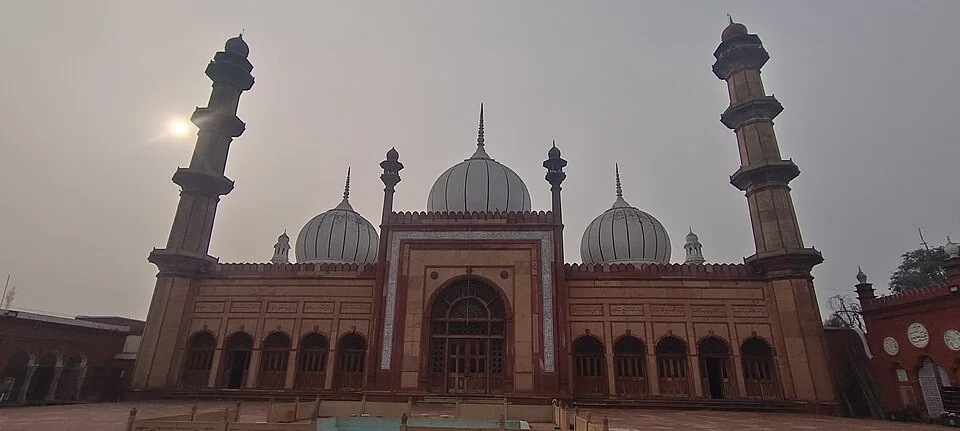
Jama Masjid within the university is a separate worship stop along the educational-heritage route. This photograph shows the AMU mosque; do not automatically identify another city mosque by the same name. Observing its arches, domes and minarets from a permitted exterior point can provide an architectural focus. Ask staff about entry, clothing, footwear and photography, and avoid obstructing movement during worship. Any commemorative or burial setting associated with Sir Syed should be approached with respect distinct from ordinary campus movement. People attending classes or prayers should not become the scenery for your photographs. If a worship stop is closed, continue to an authorised museum or urban section without spending the entire day searching for alternative entry. The aim of an educational-heritage programme is not to take a photograph inside every structure, but to establish an intelligible relationship between institution, architecture and city life. A short permitted exterior observation can still contribute to that purpose.

Lock commerce and a western Uttar Pradesh meal
The district administration clearly records Aligarh's lock-making identity. Looking at a sales shop during the city day differs from entering a production workshop without permission. Arrange an appointment if a private working space particularly interests you. For meals consider examples such as kachori with a vegetable accompaniment or jalebi, documented within western Uttar Pradesh's culinary setting. The national tourism food record for nearby Agra establishes these names; they are not presented as recipes originating exclusively in Aligarh or products stocked by every shop. Choose an example present on the menu you actually encounter in Aligarh and ask about its preparation. For a kachori breakfast establish the filling and the accompanying vegetable portion; sweet jalebi need not replace a main meal. A rice- or bread-based plate with vegetables can also work for lunch. Adding a seated meal to the shop section helps organise the day between university and fort movements. No business is promoted as a currently verified best seller.
Choosing Civil Lines, campus access or station convenience
Compare an address towards Civil Lines or with convenient university access against your educational-heritage appointment, and a property with straightforward station access against an early train. An area name does not establish that every street is quiet. Discuss the actual entrance, vehicle approach, night noise and luggage storage. Two nights in one room create a full day between arrival and departure. For several museums or a lengthy research appointment, adding a third night and second complete day may be more realistic. Accommodation is not a means of obtaining informal access to a private campus section. University-gate rules apply independently of where you sleep. Families should think about fort surfaces and vehicle links between stops, without assuming every urban journey is a comfortable walking tour. If a brief park break appeals in the afternoon, let it replace an existing part of the programme instead of treating it as another compulsory addition. Choose a room that supports actual confirmed visits.
Departure, an extra day and the visit boundaries
Protect the booked connection on the last day. Automatically moving an unfinished campus section into departure morning may overlap an appointment with a train. Shekha Bird Sanctuary and worship places outside the urban core can require separate routes; do not insert them into the full day without recalculating transfers. When birdwatching is the main interest, replace an academic-heritage section or add a day. The three-day core does not claim to complete the university, entire district and lock-production chain. Sources were reviewed on 4 October 2026. Follow current institutional instructions for library membership and guest distinctions, campus permission and fort access. The Stork's short programme helps approach Aligarh as a living educational and commercial city: attention to one heritage focus, a fort visit and a real meal. That framework can create a meaningful sightseeing day without trying to force entry to a closed setting or promising services the current visitor has not confirmed.