
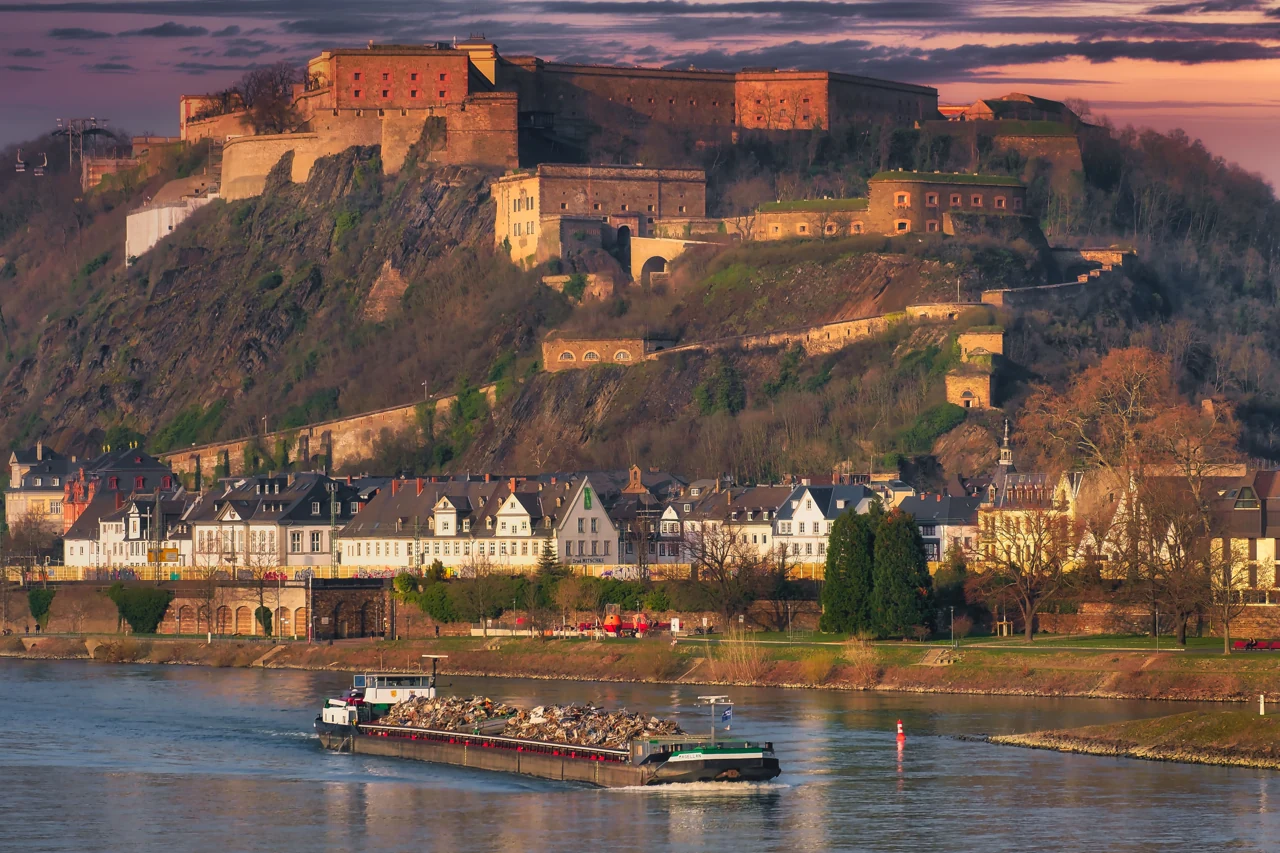
A day in Koblenz becomes easier to plan when you separate the level riverside walk from Ehrenbreitstein on the opposite hillside. Deutsches Eck, the old town and the Rhine bank connect within one city programme, while the cable car takes you to another elevation and a separate cultural site. Buying a cabin journey is not the same as entering all fortress exhibitions. This guide clarifies ticket coverage and the return journey for a first-time visitor who wants to see the river confluence and give the fortress real time. Someone chiefly interested in scenery can also have a complete day at river and street level. Decide how much time the upper site deserves instead of treating the cable car as a compulsory brief photograph stop.
Koblenz Hbf to the old-town streets
The official DB page for Koblenz Hauptbahnhof identifies the train-arrival point. Include the approach to the old-town core in your plan; leaving the platform does not place you immediately at Deutsches Eck. Storing a heavy bag at your accommodation first can simplify both the city walk and the fortress journey. Head towards the centre through shopping streets and smaller squares. Look at the first facades and side lanes instead of using the entire approach as a hurried transfer. A short seated pause after a long train journey may make the subsequent outdoor sections more comfortable.
Germany's official tourism portal suggests the Vier Türme surroundings as an old-town starting point. Within the street, the name becomes a reference to corner-house bay windows rather than four separate large towers. Continue through the Münzplatz surroundings towards the waterfront, observing how squares and lanes connect. You need not tick off every central feature. Examining a few old-town details before moving to the river's broader scale makes the change in scenery more noticeable.

Deutsches Eck: the open space at the confluence
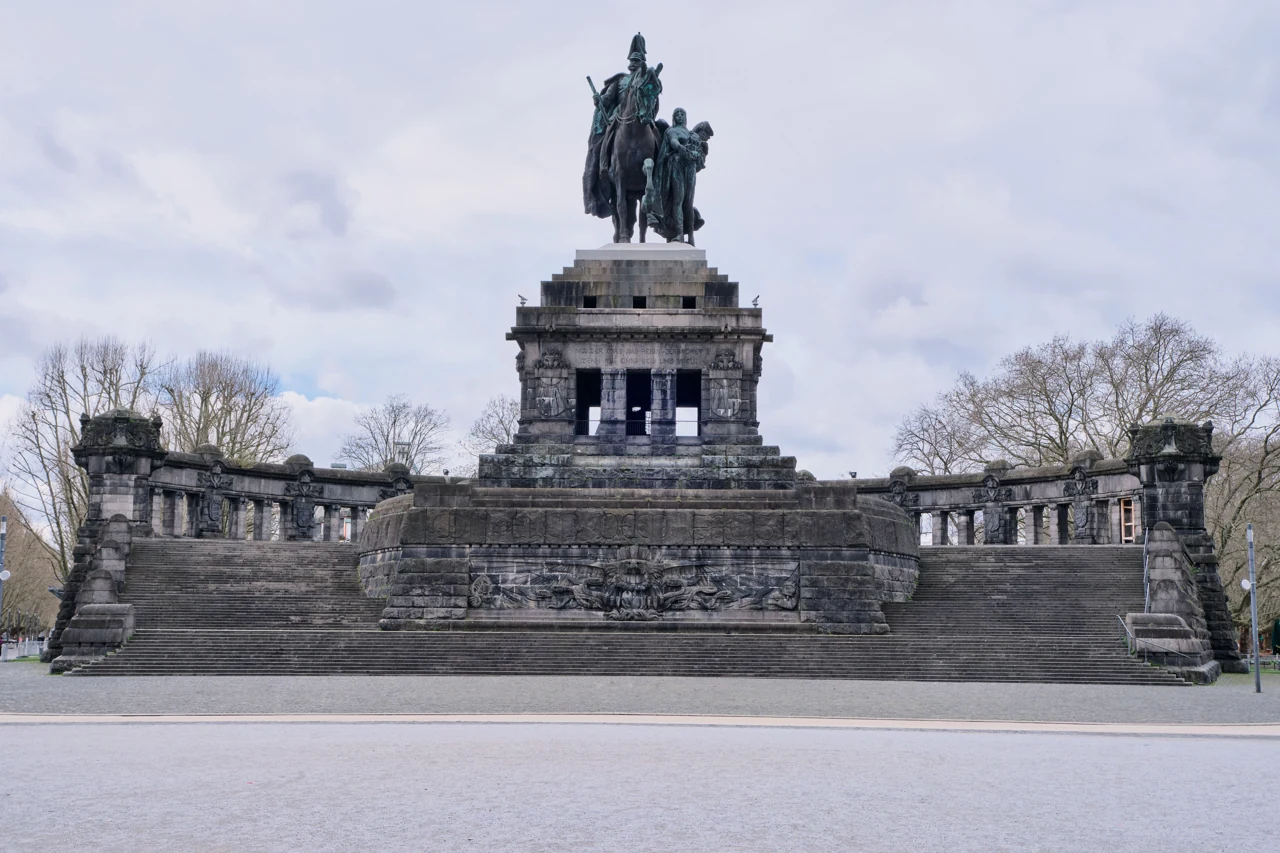
At Deutsches Eck, observe where the Mosel joins the Rhine from waterfront level. The wide monument setting offers a different kind of pause from the narrow old-town streets. Look beyond the monument itself towards the water on both sides and the fortress across the river. If ascending later, remembering this view helps explain the relationship between the waterways from above. The riverside wind can feel different from conditions in sheltered lanes. Change your position for photographs without establishing a lengthy fixed setup in a space people are continually crossing.
A sightseeing boat visible beside the bank does not establish continuous departures on every possible route that day. If adding a cruise, plan from an actual operator's departure and return information. A longer river excursion on a fortress day may require reducing another section. For a shorter visit, walking beside the Mosel and Rhine may be enough. With limited time before the return train, completing the waterfront and returning through town can be more comfortable than making a rushed cable-car decision.

Cable-car travel and fortress admission are different
The Seilbahn Koblenz operator's ticket page lists one-way, return and other journey products separately. Check explicitly whether you are buying travel alone or a combined product that includes cultural-site admission. The lower station is on Konrad-Adenauer-Ufer, while the upper station is on the Greiffenklaustraße side. Reaching the hill still leaves walking time to the fortress sections and exhibitions you select. The cabin panorama is an experience of its own rather than a completed tour of the fortress content.
Read the last return departure separately. An exhibition or fortress-ground opening time does not guarantee the cable car runs until the same hour. With a one-way ticket, choose an actual method of descending in advance. Do not treat alternative transport or an unfamiliar downhill walk as an unconditional last-minute solution. Compressing time across the river into a small gap before a train may make the most scenic section unnecessarily hurried. Ticket coverage and the last descent are two practical decisions to settle before concentrating on the photograph angle.
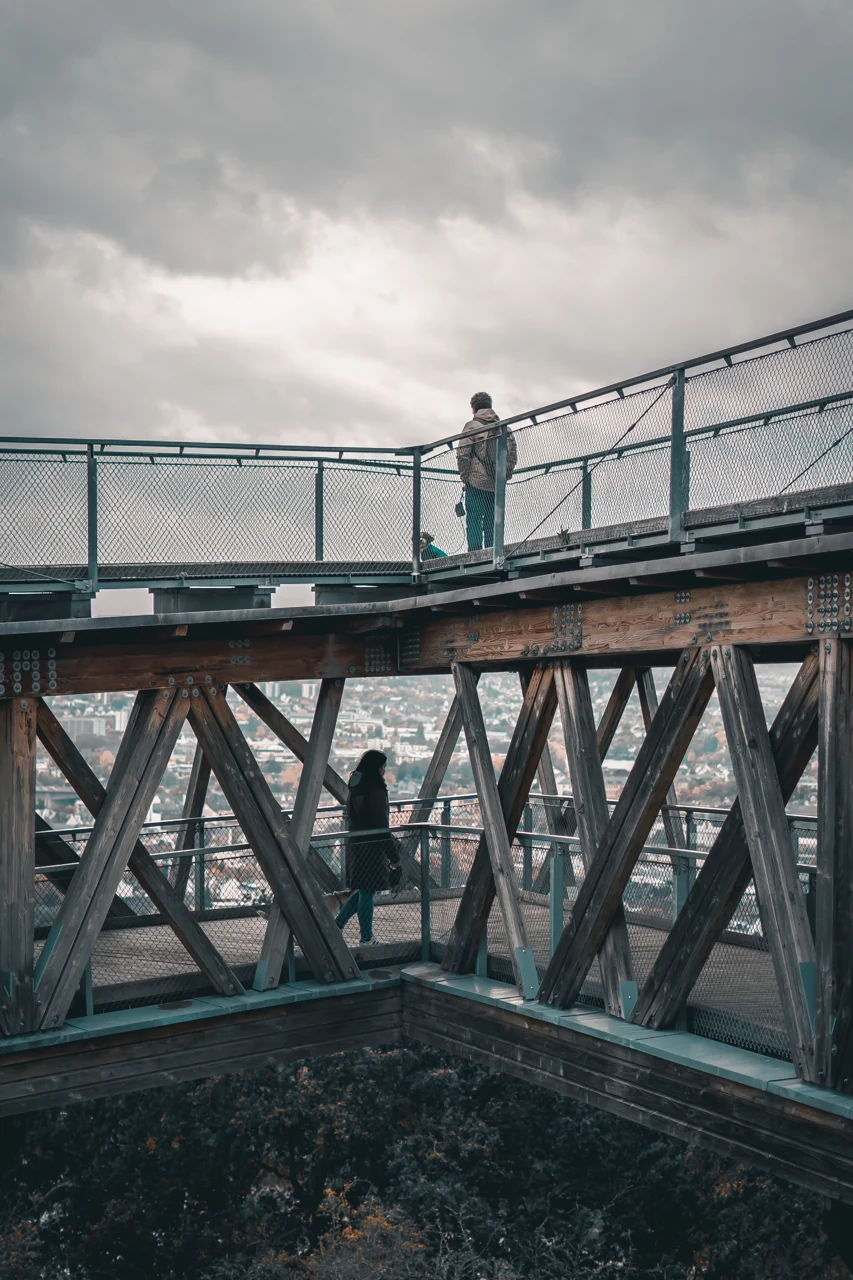
Ehrenbreitstein: views and selected exhibitions
The actual cultural-site operator publishes arrangements for fortress grounds and exhibitions. These vary seasonally; not every exhibition house follows the same daily winter programme. Evening access to the grounds is also different from access to daytime displays. Begin with the city-and-confluence viewpoint, then select one or two sections that interest you. Exploring without pressure to enter every building gives room to understand the fortress itself as well as its relationship with the town below.
The operator's accessibility information describes ramps and lifts throughout many areas while identifying particular sections still reached by steps. A general accessibility statement does not imply every room can be visited in the same way; ask about the specific route you need. A bunker tour or special event requires separate current information and cannot be guaranteed by ordinary admission. After a pause above the town, review your return timing and descend to the river. An evening city walk is more enjoyable when it is not organised as a race against the last cabin.
A real main meal at Altes Brauhaus Koblenz
The Altes Brauhaus Koblenz menu page belongs to the actual centre restaurant at Braugasse 4. Do not confuse a similarly named business or another branch with the Koblenz reservation. Its linked current menu lists beef Sauerbraten prepared to the house Mölich recipe with dumplings and red cabbage. This provides a real seated main within the programme. A regional name alone does not establish whether the meat and sauce suit your preferences, so explain requirements before ordering.
Putting the meal after the fortress return removes pressure to finish at the table in time for the uphill journey. If eating first, recalculate when you can reach the upper site. Confirm kitchen service and table availability directly; an online menu is not a guarantee of a vacant table. Companions with different dietary preferences should examine the same current card and ask for suitable options. Prices and dishes can change, so a figure on an older city blog need not be today's charge. The itinerary becomes concrete when it gives lunch or dinner actual time as well as allocating time to the views.
Hotel Brenner and a comfortable station return
Hotel Brenner is a real Koblenz accommodation option. Its own guest information describes proximity to Hauptbahnhof, parking away from the property and advance contact for later arrivals. A room reservation alone should not be interpreted as a staffed desk waiting indefinitely at the door; establish the arrival arrangement. Confirm parking availability and the current charge with the booking. Staying on the station side of the centre can suit someone continuing to another city by train the following morning.
With an overnight stay, you can give the old town and river the first day and keep a longer fortress or exhibition visit for the next. A day trip instead needs a comfortable gap between the upper-site return and the train. This route's particular strength is seeing the same two rivers at waterfront level and from the opposite slope. Keeping the cable-car journey, fortress entry and exhibition access as separate decisions makes both the broad panorama and the smaller city streets easier to enjoy.