

Rouen: two institutions and the street between them
If combining an art collection with a historical narrative in Rouen, choose dates around more than a cathedral photograph. Two nights can provide an arrival walk, a following morning at Musée des Beaux-Arts and afternoon at Historial Jeanne d’Arc, then a short final city return. Wednesday or Thursday offers a common ordinary opening day; the sequence differs on Monday and Tuesday. Tatilmerkezi Stork suggests distinguishing the story within a museum image from the story of a frontage observed while walking. The cover shows Rouen cathedral's tall stone exterior and towers on 18 September 2006. It establishes neither a projection show on a particular October evening nor unrestricted access to every interior section.
The city railway station is Rouen Rive Droite, with SNCF giving Place Bernard Tissot as its address. Reaching the older centre from here is a different starting task from arriving on the opposite bank of the Seine. Check the actual train connection and final return option together. Leaving heavy luggage at accommodation first can make walking among stone and timber fronts easier. Choose a property around station access and movement between the two cultural institutions; obtain room floor, lift and luggage-storage details directly. A late arrival may justify preparing the next morning's entry instead of extending a museum programme. If rain slows the walk, protect the two selected visits and full meal before adding more streets.
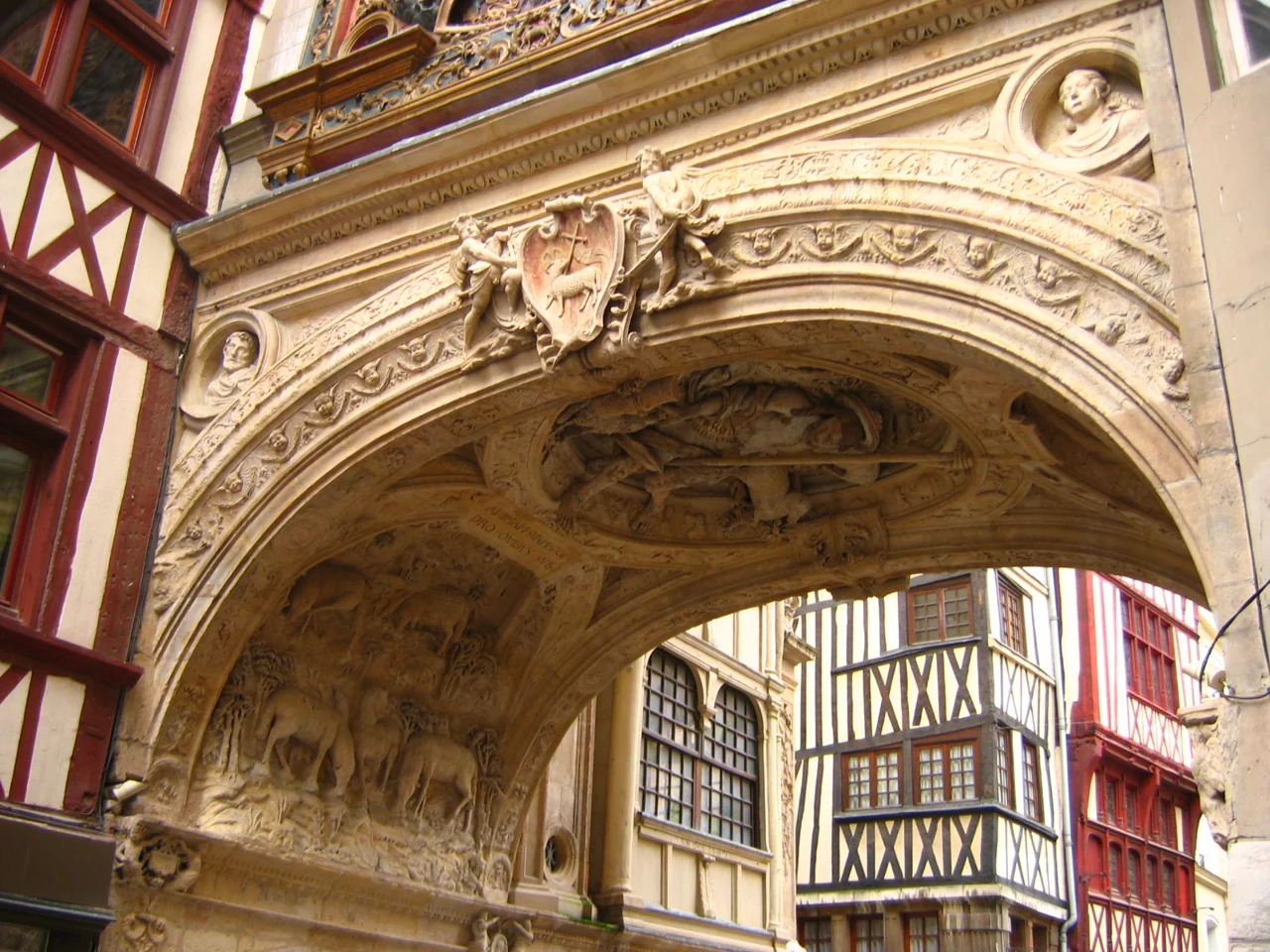
The Gros-Horloge passage: examine the underside
The second photograph shows the decorated stone underside of the Gros-Horloge passage and surrounding timber fronts, in Urban's actual 2005 image. Do not describe an easily readable clock close-up: the visible subject is the underside and street scale. On your walk, compare the relief above with how the narrow opening directs people's movement. Looking beneath an outdoor arch provides neither an interior ticket nor permission to go up for a high viewpoint. This route gives no definite tower-ascent schedule. Keep any close photography stop brief where people are passing. Examining a historic timber front does not extend the photograph's permission to reproduce a contemporary work displayed in a window or enter a private interior.

The principal art-collection address is Esplanade Marcel Duchamp. The official Musée des Beaux-Arts information checked on 5 October 2026 gives 10am–6pm admission and Tuesday closure, with the permanent collection free and temporary exhibitions potentially having separate conditions. Apply additional closures on 1 January, 1 May, 1 and 11 November and 25 December. The accessible entrance is identified as 26bis Rue Jean Lecanuet, so do not assume the main entrance suits everyone. Selecting one collection section in the morning leaves room for a proper meal before the history institution. Admission to two different museums is not one transaction. Compare two pictures through light or movement, then relate that observation to the passage function of the outdoor arch.
Rue Saint-Romain and current Historial access
The third image is Chabe01's actual Rue Saint-Romain street photograph from 14 November 2021. Stone and timber fronts, paving and pedestrians are visible; it is not a scanned historical engraving. The substantive history institution here is Historial Jeanne d’Arc, at 7 Rue Saint-Romain. Keep your outdoor walking pace distinct from the sequence of its interior narrative. Standing before a house doorway grants no access to private property. Choose a frontage detail instead of blocking a narrow passage with a lengthy pose. Present-day digital displays inside the museum are excluded from the guide's photo set. The street establishes historical surroundings rather than an invented personal memory of viewing the presentation or a reproduction of its contemporary imagery.


The Historial's current practical page gives Tuesday–Sunday, 10am–7pm, with the final digital-route departure at 5:15pm, and Monday, Christmas Day, New Year's Day and 1 May closures. The same page explicitly reports a lift failure currently preventing wheelchair users from reaching upper floors. Do not let a general access label obscure that notice; establish the conditions you need directly with the institution. Heat alerts may change hours, but this conditional policy is not a claim that such an alert occurred on 5 October. Free wandering on two September heritage days is not ordinary October admission. Because the art museum closes Tuesday and the Historial Monday, it is equally wrong to conclude that every cultural venue shuts on the same day.
The Saint-Ouen exterior and a real Rouen main course
The fourth photograph shows Saint-Ouen's large stone volume, buttresses and grass in front, captured by Daniel Vorndran / DXR on 15 February 2014. Its source title contains a direction label; this guide uses the visible exterior without asserting that orientation from the image. Leave this observation until the final morning if the museum day grows lengthy. Municipal 2026 documents track restoration of the building, so the older photograph establishes no identical present-day surroundings. Check current admission separately for an interior or particular event. This route compares a historic exterior with smaller door and street scales; it adds neither an open exhibition nor today's organ recital automatically. Times attached to a past May event do not form a new visit schedule.


For a concrete Rouen meal, La Couronne's operator page at 31 Place du Vieux-Marché still links an explicitly spring/summer 2026 menu. It offers canard à la rouennaise prepared with a press in the dining room, for two people in two servings, with booking advised; do not invent an accompaniment from its name. The document separately lists roast duck fillets with Pommeau and Darphin potatoes, giving a specific main-course alternative to ask about when dining alone. Retain the seasonal label: the same plate or price is not guaranteed in October. Confirm the actual dish, ingredients and service for your date when booking. The Saint-Ouen image depicts neither a restaurant table nor food, and no supposedly tasted flavours are fabricated.
From the judicial frontage to the return train
The fifth image shows pointed stone decoration and a steep roof outside Palais de Justice, photographed by Urban in December 2004. It is a distinct city scene from the cathedral frontage, arch underside, smaller street and Saint-Ouen volume. Standing outside a courthouse does not provide unrestricted access to working areas. Use this final stop as an exterior observation, comparing large openings with the nearby street scale. The picture establishes neither present wayfinding nor security arrangements. Adapt your walk to any actual staff instruction. With children, locating one small stone detail may make a more manageable exercise than reciting the building's entire history. No remembered meeting with a guide is added to the account.


First reserve the actual luggage-collection time and margin for returning to Rive Droite. Completing a city walk need not require adding the other bank and a distant town to the same morning. Two separate admission calendars, the Historial's current lift failure and a restaurant menu carrying a seasonal label are practical conditions that may change the visit. Revisit a street instead of adding a third interior whose admission you have not checked. Without presenting Rouen as the completed entirety of Normandy, examine an art collection, a historical narrative, different exterior scales and a main meal that can genuinely be discussed with its operator. The sequence remains a framework that can be shortened for real access or rest requirements.